The queue of trucks at an enterprise’s gates is usually perceived as a logistics problem. Trucks arrive early, occupy the holding area, stand along the road or on the approach to the enterprise — which means they somehow need to be let through faster.
But for the enterprise manager, the problem is much broader.
When dozens of trucks arrive at the gates at the same time, the issue is not only vehicle downtime. The workload of the weighbridge, laboratory, checkpoint, loading and unloading equipment, and personnel becomes uneven. At some hours, the enterprise’s capacity is underutilized; at others, it operates at full capacity. More holding space is needed, dispatchers spend time coordinating by phone, and drivers and carriers wait for hours in the queue.
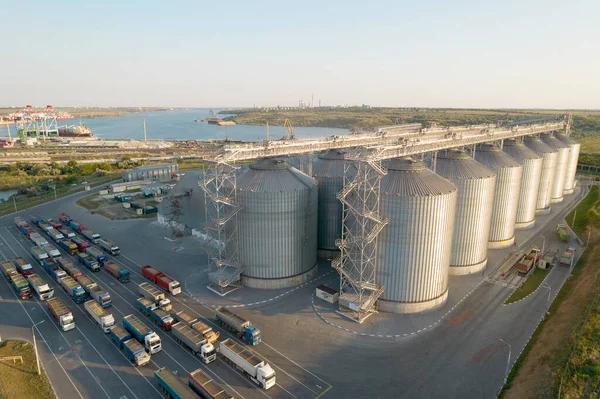
The electronic queue changes the very principle of organizing this process: the enterprise stops managing trucks that have already arrived and starts managing those that are only planning to arrive.
This is where its main economic benefit arises.
Not a “queue at the gate”, but a managed flow of transport
The traditional operating model is simple: the driver tries to arrive as early as possible because the rule is first come, first served — whoever arrives first is served first.
This creates a paradox: all participants try to arrive early at the same time, and the enterprise receives a flow of vehicles that it cannot physically process.
For a grain terminal or elevator, this means an overcrowded holding area and queues at the entrance. For a port, it means grain trucks gathering on approach roads and city streets. A warehouse or another cargo-handling enterprise faces a similar problem of uneven vehicle arrivals.
This is the problem that Art:Queue solves.
The system is designed to create an electronic queue and allocate time intervals — time slots — taking into account cargo type, technological requirements, and the enterprise’s specific business process. It can be used at elevators, grain and cargo terminals, ports, warehouses, customs terminals, and other facilities.
The logic changes fundamentally: not “the truck has arrived — now we’ll decide what to do with it”, but “the enterprise knows when the truck should arrive, what cargo it is carrying, and where to direct it”.
The system is based on the enterprise’s production plan.
For example, an elevator determines in advance which crop, in what volume, and on which line it will receive during the day. A terminal can plan a vessel’s loading or unloading and distribute the truck flow accordingly. A port can organize vehicle entry through a holding area, taking into account the current situation on the premises.
An electronic queue is formed on this basis.
The driver, carrier, logistics operator, or shipper submits an application, after which the truck is assigned an appropriate time slot.
The system supports two different ways of organizing entry.
Individual time slot
Each truck is assigned a specific arrival time directly at the enterprise’s gate or at the holding area.
Group time slot
A shared time window is created for several trucks — for example, 10–15 vehicles.
First, the trucks arrive at the holding area or checkpoint. After their actual arrival is confirmed, the system assigns each truck an individual slot for further entry.
This approach is especially useful for ports and terminals, where external logistics needs to be separated from the internal production process.
What the System Includes
Art:Queue is not just an electronic spreadsheet listing vehicles.
Depending on the enterprise’s operating model, the solution may include several workstations and applications:
- Queue Operator workstation — the workplace of the employee managing the queue;
- Driver’s Personal Account — the «Art:Line» web application for submitting requests and working with the queue;
- Holding Area Dispatcher workstation — management of vehicles that have already arrived at the holding area;
- Cargo Receiver’s Account — for example, for a stevedore or another cargo receiver;
- Shipper’s Account — for a supplier, trader, or other shipper;
- Carrier’s Account and Logistics Operator’s Account — for carriers and the enterprise’s logistics staff, allowing them to nominate trips, submit and create transport requests, and prepare completion certificates and other documents for completed trips;
- Art:Registrar mobile application — confirmation of actual truck arrival and data verification;
- integration with other enterprise systems, if required.
The composition of the solution is not fixed. It can vary depending on the business process of a particular enterprise.
The system can operate as a standalone solution, be integrated into an existing accounting system, or be used together with the industry-specific solutions Art:Grain Terminal, Art:GrainStorage, and other Art Port products. It can run on the customer’s servers or in the cloud.
From Request to Entry: What Happens to the Truck
The process starts before the truck even leaves for the enterprise.
The driver or logistics operator submits an entry request. The driver can submit a request only for themselves, while a logistics operator can submit a group request for several trucks. The system approves the request and the driver receives an entry time — a time slot.
When assigning a time slot, the following can be taken into account:
- vehicle type and specifications;
- crop or other type of cargo;
- supplier or shipper;
- priority;
- required technological breaks;
- processing time;
- the enterprise’s production plan.
Vehicle and volume data can also be uploaded, including in bulk. This is important for large customers and fleets planning a large number of trips at once.
After departing, the driver changes their status to “On the way” in the Art:Line app, and the queue dispatcher can see that the truck has set off towards the enterprise.
On arrival at the checkpoint or holding area, the driver also records this by pressing the relevant buttons in the app. If necessary, on-site staff can use the Art:Registrar mobile app to confirm actual arrival, check consignment note data, register the truck, and contact the driver.
The enterprise then decides exactly when to call the truck onto its premises.
This creates a fully managed cycle: request → time slot → departure → arrival at checkpoint / holding area → call for unloading/loading → checkpoint → processing → departure.
But where is the money?
This is precisely the most important question for the director.
If the electronic queue simply replaces a paper vehicle list with a digital one, the economic benefit will be limited.
But when it becomes part of transport-flow management, benefits arise in several areas at once.
1. Less Paid Vehicle Downtime
The most obvious benefit is reducing the time a truck spends waiting.
If a truck waits for one hour instead of two days, for example, the carrier can complete the trip sooner and send the vehicle on its next assignment.
For the shipper or depositor, this means lower transport costs.
For the terminal itself, it is an additional competitive advantage in attracting customers.
If two enterprises offer comparable receiving terms, but a truck is processed in an hour at one and waits for two days at the other, carriers and cargo owners quickly take this into account. With the current labour shortage, keeping a truck and its driver waiting in a queue is too expensive. These are not only direct losses but also lost revenue: instead of waiting pointlessly at the terminal gate, scarce resources could perform other trips and generate actual income.
2. The Electronic Queue Helps Use Production Capacity More Efficiently
For a grain enterprise, it matters not only how many trucks arrive, but also what they bring and when. This determines the workload of the weighbridge, receiving lines, and other process equipment, as well as staffing and electricity requirements.
Imagine this situation: few trucks arrive at the elevator in the morning, so the weighbridge and receiving lines are only partially loaded. Then, over two hours, dozens of trucks arrive at once, and the enterprise physically cannot receive them all immediately. A queue forms, and once it clears, the equipment may again be underutilized.
The paradox is that an enterprise may have sufficient production capacity to process the daily grain volume but fail to use it efficiently because vehicles arrive unevenly.
The electronic queue distributes vehicle flows using time slots, aligning truck arrival times with the enterprise’s capabilities and current production plan. The system does not increase the physical throughput of the weighbridge or receiving line, but it helps make fuller use of existing capacity and, under certain conditions, increase actual throughput without building new facilities.
Another source of savings is scheduling trucks carrying different crops in the right sequence. For example, if an elevator has separate receiving lines for corn and wheat, chaotic arrivals may leave both lines underloaded. If the process allows intake to be organized in periods, the queue can be arranged so that corn arrives mainly during the first part of the shift and wheat afterwards. This concentrates vehicle flow on a particular processing line, reduces unnecessary changeovers, and uses equipment more efficiently. The result may be savings in electricity and operating costs.
Queue planning also helps optimize shift workloads. If the system shows that few trucks are registered for the night shift, the enterprise can consider moving some vehicles to the next shift. This avoids running equipment and staffing it for a small volume of work. If rescheduling is compatible with the production schedule and customer agreements, it can reduce electricity, labour, and equipment operating costs. The queue can be rearranged, and drivers can be automatically notified of the changed time slot and the reason for the change.
Thus, the electronic queue becomes not merely a transport-management tool but a way to align the external flow of trucks with the internal production plan. The manager can control not only truck arrival times but also the sequence in which crops are delivered, the workload of processing lines, and the distribution of work between shifts. This coordination is where additional economic benefits arise for the enterprise.
3. The Need for a Holding Area Can Be Reduced
A holding area addresses the problem of trucks that have already arrived and helps prevent queues directly at the enterprise gates. However, the traditional approach has a downside: large numbers of grain trucks gather in one place. Amid frequent air-raid alerts and the threat of missile or drone strikes, such a dense concentration of people and vehicles creates critical safety risks.
An electronic queue helps prevent trucks from arriving all at once. If the enterprise knows the vehicle reception schedule precisely, drivers do not need to arrive several hours before their assigned time. Some trucks can remain at the shipper’s premises or at a safe, remote site.
The two tools work together as follows:
- Managed dispersal: the enterprise can define a waiting zone by setting minimum and maximum distances from the facility, within which vehicles should remain.
- Automated calling: the dispatcher sees vehicle status and location, while the automatic notification system (for example, an automated call) contacts the driver exactly when the receiving line or unloading point is ready to work.
- Cost reduction: there is no need to gather dozens of trucks in one physical holding area “just in case”.
As a result, the holding area and electronic queue do not compete with each other but complement one another: the former physically accommodates vehicles when necessary, while the latter manages the flow, replacing a fixed concentration of trucks with flexible remote control.
This gives the enterprise a combined economic benefit:
- The required holding area and its maintenance costs are reduced.
- Costs associated with organizing vehicle movements are reduced.
- The workload of support staff is reduced.
- Risks associated with the simultaneous concentration of people and equipment in one place are minimized.
4. Less Manual Work — Lower Operating Costs
Without an electronic system, transport management often looks something like this: phone → messenger → spreadsheet → call to driver → confirm truck number → call dispatcher → change the queue → another call.
With a large number of trucks, this turns into a full-scale manual dispatching operation.
Art:Queue moves this process into a single system.
The operator sees requests and vehicle statuses, can manage slots, change the order of movement, and inform drivers.
The system supports SMS, a Telegram bot, automated calls, and push notifications about events such as joining the queue, departure, delays on the road, arrival at a checkpoint or holding area, calls to the terminal, and so on.
This means more than simply making the dispatcher’s job easier.
Every operation that previously had to be performed manually takes an employee’s working time.
With a high volume of transport, the number of such operations can be substantial.
Automated calling directly saves dispatchers’ working time. For example, with 200 trucks per day, 1–2 calls lasting 1–2 minutes each amount to 6–10 hours of telephone work per day that can be handled by automated calling.
5. Lower Losses from Data Entry Errors
Another source of savings often goes unnoticed.
When data about a truck, driver, and cargo are transferred several times from one source to another, the likelihood of errors increases.
In Art:Queue, information can be entered in advance, including on the basis of consignment notes, and the enterprise’s employee verifies it when the truck actually arrives.
This reduces repeated manual data entry and makes the control process more transparent at the same time.
For large enterprises, even a small reduction in errors over a season can have a measurable financial effect by shortening processing time and eliminating delays caused by errors.
6. One Vehicle Flow Can Be Connected to Several Cargo Receivers
For ports and large terminals, this creates another important benefit.
One electronic queue can be used by several cargo receivers.
For example, a holding area receives trucks, after which different cargo receivers can see their own vehicles and call them for loading or unloading in accordance with their production plans.
Thus, one system can connect: carrier → holding area → port/terminal → specific cargo receiver.
The receiver can see how many trucks have arrived, which ones are in the holding area, and independently manage when they are called forward.
For ports with many participants, this is not merely a matter of convenience, but of coordinating several business processes within a single vehicle flow.
7. The Manager Gets a Real-Time Picture of What Is Happening
Another point is especially important for the director.
The queue stops being “something the dispatcher deals with”.
The manager receives up-to-date information:
- how many trucks are in the queue;
- how many are on the way;
- how many are in the holding area;
- how many are being serviced;
- what cargo the trucks are carrying;
- how many vehicles are waiting to be processed;
- how the current situation is developing.

This allows the manager to see not only that a queue has formed, but also why it has formed.
For example:
- Is there a shortage of vehicles? Or, conversely, have trucks arrived all at once?
- Is equipment capacity insufficient?
- Has one of the processing lines stopped?
- Is the holding area full?
- Has the production plan changed?
- And so on.
This makes a fundamental difference to enterprise management.
The Electronic Queue Helps Not Only During Normal Operations
Vehicle flows are especially difficult to control when the original plan changes unexpectedly.
Equipment failure, changing weather conditions, a temporary shutdown, an air-raid alert, or changes in shipment priorities may all require the original schedule to be revised.
Instead of manually calling a large number of drivers, the operator can change the queue order with one click and notify participants through the communication channels provided by the system.
The system also makes it possible to account for unusual situations, manage priorities, change vehicles’ positions in the queue, and monitor their actual locations.
Important Note: Why the State “єCherha” Does Not Replace “Art:Queue”
There is sometimes a mistaken belief that there is no need to implement an in-house digital queue if the national “єCherha” system already exists. However, the two systems have fundamentally different purposes:
The state “єCherha” system was created exclusively to regulate road transport at border crossing points and manage border crossing. “Art:Queue”, by contrast, is a tool for organizing external logistics at your own enterprise (an elevator, plant, or terminal). It manages loading and unloading slots and synchronizes with your accounting system, weighbridge, and laboratory, addressing internal business-process tasks that the state service does not cover.
How to Calculate the Economic Benefit for Your Enterprise
The director does not need to start by calculating the software cost.
First, calculate the cost of the existing problem.
The minimum set of data:
- N — number of trucks per year or season;
- T1 — average waiting time before implementing the electronic queue;
- T2 — expected waiting time after implementation;
- C — cost of one hour of truck downtime.
The potential benefit from reducing downtime can be estimated as follows:
Economic benefit = N × (T1 – T2) × C
For example, if an enterprise handles 20,000 trucks per season and average waiting time can be reduced from three hours to two, at an assumed downtime cost of UAH 500 per hour:
20,000 × (3 − 2) × 500 = UAH 10 million.
This is only an example calculation. The actual cost of an hour of downtime depends on the specific vehicle, transport conditions, and who bears the cost.
But there is something more important for the manager.
The entire economic benefit of an electronic queue should not be reduced to the cost of truck downtime alone.
The total benefit consists of several components:
- savings for carriers and customers;
- lower costs of manual management;
- more efficient equipment utilization;
- reduced need for holding areas;
- lower losses caused by errors;
- reduced process-related downtime;
- increased actual throughput of existing infrastructure.
That is why a simple calculation comparing “software cost versus the cost of an hour of downtime” may underestimate the project’s real return.
To summarize, all the benefits of implementing an electronic queue can be brought together in a clear “Before” and “After” table.
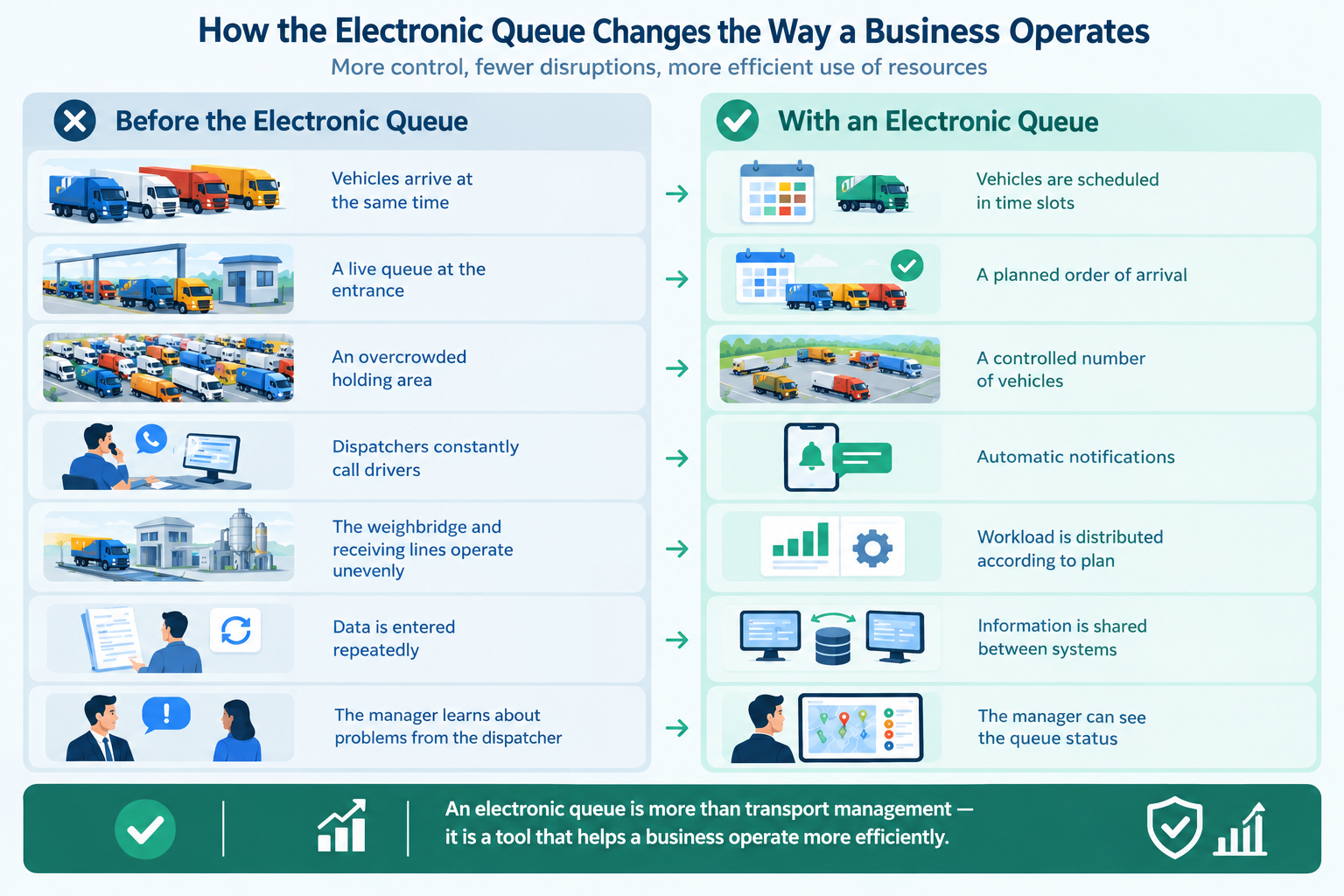
Economic benefit = reduced downtime + higher capacity utilization + lower operating costs + reduced need for a holding area
An Electronic Queue Is More Than a Digital Pass to the Premises
There is an important point to consider when choosing a system.
If the electronic queue operates on its own and is not connected to the enterprise’s other processes, its capabilities are limited.
The most significant benefit appears when information passes through the entire chain: request → planning → transport → holding area → checkpoint → weighbridge → laboratory → unloading/loading → departure.
That is why Art:Queue can be integrated with the enterprise’s existing information system and used together with Art:Grain Terminal, Art:GrainStorage, and other Art Port products. If necessary, the system can be integrated into the customer’s existing automated process control system.
The economic benefit of integrating the electronic queue into the actual production process will be significantly greater.
What the Director Ultimately Gets
Viewed from the top level, Art:Queue solves several tasks at once.
- For logistics: the enterprise knows in advance who should arrive, when, and with what cargo.
- For production: the weighbridge, laboratory, receiving lines, and loading equipment receive a more predictable workload.
- For carriers and drivers: drivers spend less time waiting and have a clear sequence of actions.
- For customers: transparency improves — they can see the status of their vehicles and understand which stage an operation has reached.
- For management: a tool is provided to control external logistics and its connection with the production plan.
- For the enterprise’s economics: losses associated with uneven workloads, manual management, downtime, errors, and excessive vehicle accumulation are reduced.
Two Implementation Options: Purchasing the System or SaaS
The electronic queue can be implemented under two models: purchasing the complete software package or connecting to the system under a SaaS model, paying a connection fee and for each processed trip.
Purchasing the system may suit enterprises with a large and stable vehicle flow that want to own the solution and manage its further development independently. The SaaS model suits enterprises with a small number of trucks per day, as well as those wishing to test the electronic queue in practice before making a large initial investment.
In the second case, costs depend on the actual number of processed trips: the enterprise pays for connection and uses the system as needed. This makes it possible to start with a more affordable option, evaluate the results, and understand the economic benefit the electronic queue provides at a particular facility.
The Main Question Is Not “How Much Does an Electronic Queue Cost?” but “What Will It Deliver as Part of the Whole System?”
The cost of the software solution is only one side of the issue.
It is much more important to determine how much the enterprise is already paying today for an unmanaged vehicle flow.
If thousands or tens of thousands of trucks pass through an enterprise each year, even a small reduction in average waiting time can produce a significant result.
And if the electronic queue also enables better use of existing capacity, reduces manual work, decreases the need for a holding area, and synchronizes transport with the production plan, the economic benefit becomes much broader than the cost of downtime alone.
An electronic queue is not simply a way to remove grain trucks from the road in front of the gates. It is a tool for managing the enterprise’s external logistics and linking vehicle flow with its internal production process.
That is why the director’s main question should not be “How much does an electronic queue cost?” but “How much is our unmanaged vehicle flow costing us today — and how much of these losses can we eliminate?”
This is the right question to start with when calculating an implementation project.